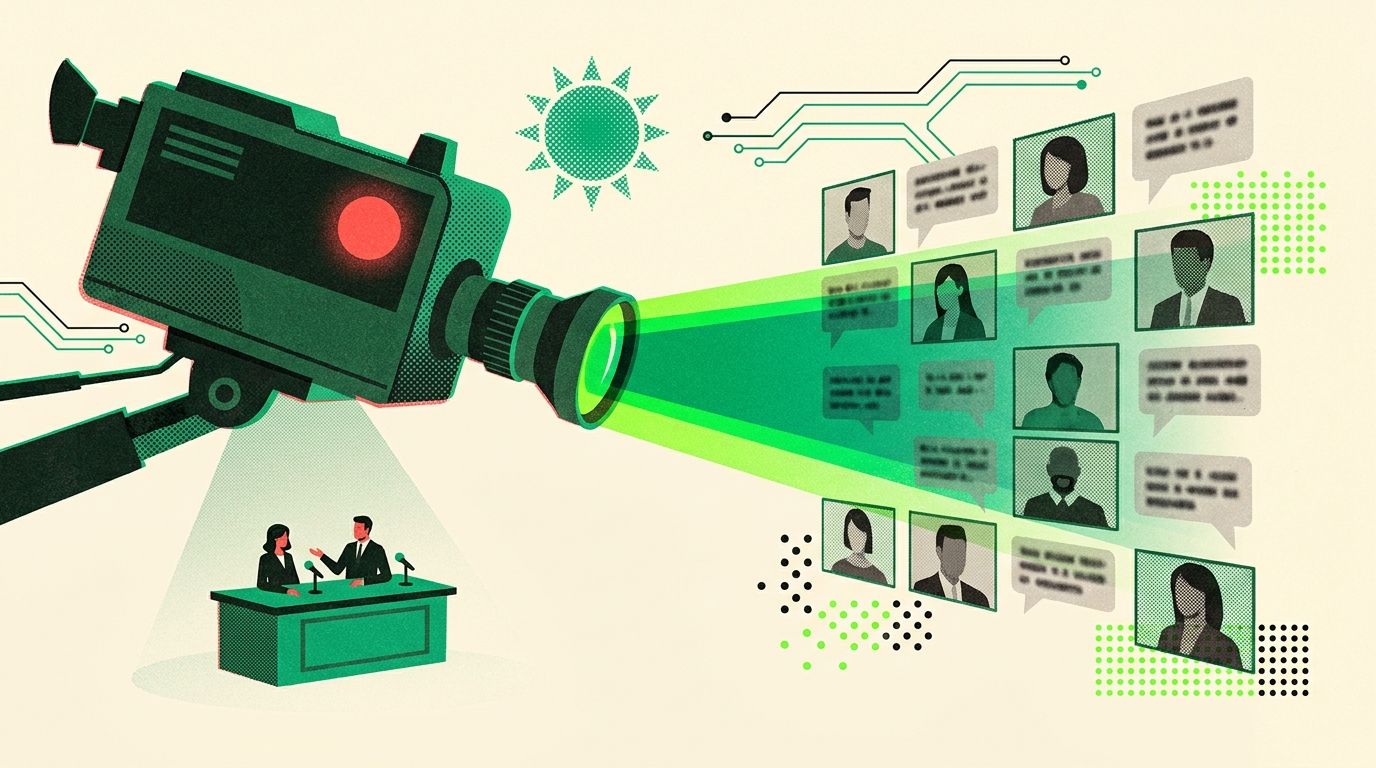
OpenAI is one of the most valuable companies on earth. It has access to the best engineers, the most computing power, and essentially unlimited capital. In April 2026, it used some of that capital to acquire a daily tech talk show called TBPN, hosted by two founders in their thirties who go live every weekday morning and riff on tech news for three hours.
That same month, a16z announced its investment in Monitoring the Situation, a 24/7 always-on livestream that runs inside X. Axios described it as Silicon Valley building its own news-industrial complex.
These are not vanity projects. These are strategic bets by people who allocate capital for a living. So we looked at both shows carefully to understand what they are actually building, why the big money is flowing toward live media specifically, and what the transferable lesson is for a B2B founder who is not sitting on a venture check.
The surprising fact: tech's smartest money is buying live media
The content production problem is effectively solved. A founder can record a decent podcast episode in a bedroom, write a solid article with AI assistance, and publish a YouTube video without a camera crew. The bottleneck is no longer production. It is attention, and more specifically, habitual attention: an audience that shows up for you predictably, day after day, because you have become part of their routine.
That kind of audience is hard to manufacture and hard to replicate. It takes time, consistency, and presence in the places where the audience already lives. When you have it, you have something genuinely scarce. And as TBPN just proved, it is something the right buyer will pay a significant price to acquire.
The OpenAI acquisition of TBPN was reported by Axios at a price reportedly in the hundreds of millions. The price was not publicly disclosed. What matters for this analysis is not the number. It is the category of asset being purchased. OpenAI did not buy a media production company. It bought a live channel, a loyal audience, and a daily habit. Distribution as an asset class.
TBPN teardown: the show that became acquirable
TBPN launched in October 2024 under the name Technology Brothers Podcast. John Coogan (ex-Founders Fund EIR, tech YouTuber, co-founder of Soylent and Lucy) and Jordi Hays (co-founder of Party Round and Capital) started it as a conversation between two operators who understood the tech world from the inside.
In March 2025, roughly five months after launch, they rebranded to TBPN and shifted format: a three-hour daily weekday livestream, airing around 11am to 2pm Pacific. The show runs simultaneously on X, YouTube, Substack, Spotify, Apple Podcasts, LinkedIn, and Instagram. The positioning is "SportsCenter for Silicon Valley," a daily live program that covers what is happening in tech the same way ESPN covers what is happening in sports: conversationally, with genuine passion, in real time.
The show attracted approximately 70,000 viewers per episode across platforms and built roughly 340,000 followers on X. Guests have included Mark Zuckerberg, Sam Altman, Satya Nadella, and Mark Cuban. That access, high-profile guests willing to come on a daily live show, is itself a product of the moat. The show became the place where the conversation happens, so the people who matter to that conversation started showing up.
On the business side, TBPN was reportedly profitable. It generated approximately $5 million in ad revenue in 2025 and had stated a target of more than $30 million for 2026. By April 2026, roughly 18 months after launch, OpenAI acquired it.
The thing that made TBPN acquirable was not a single viral moment. It was volume and consistency. Three hours a day, five days a week, simultaneously on every major platform. They iterated faster than a polished production shop could. They built a daily habit with their audience. And they did it by treating media as the main thing, not as a marketing add-on to another business.
MTS teardown: the 24/7 timeline as cable news
Monitoring the Situation takes a different approach to the same underlying thesis. Where TBPN is a structured daily show with a start and end time, MTS is a 24/7 always-on live video network that runs inside X. It covers tech, business, geopolitics, and culture by interviewing what it calls "the main characters of the moment, all day long."
The format is deliberately casual. The name is an ironic meme phrase. The aesthetic is "the X timeline as cable news." a16z's stated thesis, when it announced its investment on April 20, 2026, is that MTS updates CNN's original chaotic 24-hour news concept, the Randemonium model from the early 1980s, for an era when something is always happening on X. The mission is real-time sense-making: answering "what is happening and why" right now, in the feed where the audience already is.
The show is hosted by a16z's Erik Torenberg and Katherine Boyle. The founding team includes Chris Bakke, Theo Jaffee, Gabriel Dickinson, and Sophie (@netcapgirl). Angels alongside a16z include Dan Romero, Packy McCormick, and Zach Perrett. The investor list itself is a cast of main characters, which is not accidental. The people funding it are also the people who will appear on it and promote it to their audiences.
MTS is a more aggressive version of the in-timeline principle: it does not have a channel you subscribe to and visit. It exists inside the feed you are already reading. The show comes to you.
The Live Moat: three principles
Looking at TBPN and MTS together, a clear framework emerges. We call it the Live Moat. The thesis: in an age of infinite content, the deepest distribution moat is a live channel you own and the people who keep showing up to it. Here are the three principles that define how that moat gets built.
Always-on beats polished. The most defensible audience is a habitual one. Habits form through repetition, not quality. A daily three-hour show that is sometimes great and sometimes just fine builds a deeper moat than a monthly production that is always perfect, because it shows up in your audience's routine the same way a morning radio station does. TBPN's format is not scripted or tightly produced. It is consistent. That consistency is the product. A rare, over-produced piece of content can go viral once. A live channel that shows up every weekday at 11am becomes part of how its audience processes the world. That is the moat. We cover this more in our piece on the tradeoffs between video and audio for B2B podcasts, where the consistency argument applies just as directly.
In-timeline beats destination. Both TBPN and MTS are built on the principle that you do not make your audience come to you. You go to where your audience already is. TBPN runs simultaneously across X, YouTube, LinkedIn, Substack, Spotify, and Apple. MTS runs inside X natively. Neither show requires the audience to navigate to a separate website, download an app, or subscribe to a newsletter first. The content is in the feed, in the moment, native to the platform. The friction of "go somewhere to consume this" is the biggest killer of habit. If your content requires your audience to change their behavior to access it, most of them will not bother. If it appears where they already are, the habit forms around their existing behavior.
Convene, don't broadcast. The most powerful thing a media show can do is not produce content. It is gather the right people. When TBPN hosts Mark Zuckerberg or Sam Altman, it is not just getting a guest. It is becoming the place where that conversation happens. The show becomes the gravitational hub of its category. Every guest brings their audience. Every notable appearance reinforces the show as the center of the conversation. MTS builds this into its format explicitly: 24/7 coverage of "the main characters of the moment." The show is not a megaphone for the hosts. It is a convening platform for the people who shape the space it covers. When you convene the right people consistently, the audience has a reason to keep showing up that goes beyond the hosts themselves. We see this same dynamic in how B2B podcast guests drive audience growth, covered in our B2B podcast strategy guide.
How to build a downscaled Live Moat (worked example)
Most B2B founders reading this do not have access to a16z's capital or OpenAI's acquisition budget. That is not the point. The Live Moat scales down. Here is a concrete, step-by-step version that a single founder can execute starting this week.
Step 1: Pick a weekly live slot and protect it. You do not need to go live three hours a day. You need a consistent, recurring slot that your audience can rely on. Pick a day and time that reflects when your buyers are at their desks and paying attention. Tuesday through Thursday, between 10am and 2pm in your audience's main timezone, is where we consistently see the best attendance. Put it in your calendar as a recurring meeting. Treat it like a client commitment, not a content project you can skip when things get busy. Consistency is the product.
Step 2: Go live natively in the feed. Do not build a destination. Go live on LinkedIn, X, or YouTube, depending on where your specific buyers actually spend time. For most B2B founders selling to executives or operators, LinkedIn Live is the highest-leverage starting point. For founders in developer tools, fintech, or AI, X is likely where your audience already is. For founders who want long-form discoverability over time, YouTube Live builds a searchable archive. The key is going live natively on the platform rather than asking people to click a link to a third-party stream. Reduce every possible step between your audience and your content.
Step 3: Convene guests from your category. Your first 10 to 20 live sessions should feature guests, not solo monologues. Invite customers who can speak to results. Invite partners who serve the same buyers. Invite category analysts or adjacent founders. Each guest brings their network. Each appearance gives your audience a reason to tune in beyond your own opinion. Over time, the show starts to become the place where your category's conversation happens. This is the convening principle at a founder scale. You are not trying to get Sam Altman. You are trying to get the three people in your space that your buyers most want to hear from.
Step 4: Treat it as appointment media. Tell your audience when you go live, in advance, every week. Post the guest and topic 24 to 48 hours ahead. Send a short email or LinkedIn post that morning. The goal is for a consistent segment of your audience to know that every Tuesday at noon, you go live, and this week the guest is someone worth their time. Appointment media is not about volume. It is about reliability. The audience that shows up every week is worth ten times the audience that stumbles across a one-off recording.
Step 5: Cut the live show into clips and written content. The live session is the source asset. Everything else flows from it. Take the best two or three minutes from each session and turn them into short clips for LinkedIn, X, and YouTube Shorts. Turn the key insight from the conversation into a written post or article. The live show does the hard work of generating a genuine conversation. The clips extend the reach to the audience that was not live. This is exactly the system we describe in our piece on B2B clipping strategy, and it is how one weekly live session turns into a full week of content across channels.
The whole system requires roughly three to four hours a week: one hour of live show, one hour of prep and guest coordination, and one to two hours of clip editing and distribution. A production partner like AshMedia handles the editing and distribution so the founder stays in the session and the guest relationship, not the timeline.
Five lessons from the teardown
The TBPN and MTS stories contain several distinct lessons. Here are the five we keep returning to.
Lesson one: media is the main thing, not a marketing add-on. TBPN was acquired because the hosts treated media as their primary business, not as a promotional vehicle for another product. The show itself was the product. The ad revenue, the audience, the access to guests, all of it was the direct result of that commitment. Most B2B companies treat content as a support function. The companies building the most defensible distribution are treating it as a core function. That is a different level of investment, and it produces a different level of result. See our breakdown of how this same logic applies to deep tech companies in our deep tech content marketing guide.
Lesson two: always-on creates a habit moat that polished content cannot. The production quality of TBPN is good, not exceptional. The format is loose. The value is that it shows up every day at the same time, which means the audience builds it into their routine. Habit is a moat because habits are hard to displace. A competitor can produce a better-looking show. It is much harder to break a habit. If your audience already tunes in to TBPN at 11am every morning, a newer, prettier competitor has to give them a reason to change that behavior. Most of them will not bother.
Lesson three: be native to the timeline, not a destination. MTS runs inside X. TBPN runs on every major feed simultaneously. Neither show requires the audience to go somewhere new. The friction reduction is strategic. Every additional click you require from your audience is an opportunity for them to decide it is not worth the effort. Going live natively in the feed where your audience already is turns content consumption into a zero-friction behavior. The audience does not need to decide to watch. It just appears.
Lesson four: convene the main characters and the show becomes the hub. TBPN's guest list (Zuckerberg, Altman, Nadella, Cuban) is not a perk of success. It is a compounding consequence of being where the conversation happens. The more notable the guests, the more notable the show, which attracts more notable guests. At a founder scale, this same loop works at a lower level of altitude. The point is to start convening the most credible voices in your specific category, not the entire tech world. When your buyers see their peers and admired figures appearing on your show, the show inherits their credibility.
Lesson five: distribution is now something the smart money buys and funds. This is the most structurally significant lesson from April 2026. OpenAI buying TBPN and a16z funding MTS are not content experiments. They are investments in distribution infrastructure. The underlying bet is that attention, specifically habitual, loyal, real-time attention, is a strategic asset worth paying for at the infrastructure level. That thesis scales down: a B2B founder who builds a live channel their buyers show up to consistently is building the same kind of asset, just at a smaller scale. It is acquirable, brandable, and compounding in ways that a static website or a quarterly webinar is not.
What this means if you are not OpenAI
We want to be direct about the limits of this analogy. TBPN's outcome, acquisition for a price reported in the hundreds of millions, is not what most B2B founders are building toward, and we are not suggesting it should be. Most of our clients are selling software, professional services, or technical products to other businesses. They are not trying to build the SportsCenter of Silicon Valley.
But the transferable principle is real and it is not about scale. It is about the nature of the asset you are building. A live channel that your buyers show up to consistently is a different category of asset than a blog, a brochure website, or a quarterly webinar. It is a habitual relationship. It is a gathering place for your category. It is a stream of content that feeds clips, articles, and social posts in a way that a one-off production never can.
The Live Moat framework works at the scale of one founder and a weekly one-hour show. The principles are identical to what TBPN and MTS execute at their level. Go live consistently in the feed where your buyers are. Convene the guests they want to hear from. Treat the live session as the source asset and extract everything downstream from it. That is the system.
We also want to flag what this means for how you think about content distribution more broadly. The live show is the engine. The clips are how you extend its reach to the audience that was not live. We cover the clip strategy in detail in our B2B clipping strategy piece. The written content that grows from each episode is how you build organic search presence over time. The whole system compounds. The live session generates the raw material. The clips distribute it. The articles index it. Every week you do it, the asset gets more valuable.
The most important lesson from the TBPN and MTS teardown is not the acquisition price or the a16z check. It is that two of the most sophisticated allocators in technology looked at the content landscape in 2026 and concluded that the scarcest, most valuable thing you can own is a live channel with a habitual audience. That conclusion is available to any B2B founder with a one-hour weekly slot and the discipline to show up in it consistently. Most founders are not doing it. That gap is the opportunity.
FAQ
What is TBPN and why did OpenAI acquire it?
TBPN (Technology Business Programming Network) is a daily weekday livestream hosted by John Coogan and Jordi Hays. It launched in October 2024 as the Technology Brothers Podcast and rebranded to TBPN in March 2025 when it began a three-hour daily live format across X, YouTube, Substack, Spotify, Apple Podcasts, LinkedIn, and Instagram. The show reportedly generated around $5 million in ad revenue in 2025 and had a stated target of more than $30 million for 2026. In April 2026, OpenAI acquired TBPN for a price reported to be in the hundreds of millions. The acquisition reflects the view that a live, habit-forming media channel with a loyal tech audience is a strategically valuable distribution asset.
What is Monitoring the Situation (MTS) and who is behind it?
Monitoring the Situation (MTS) is a 24/7 always-on live video network that runs natively inside X. It covers tech, business, geopolitics, and culture in real time by interviewing main characters throughout the day. a16z announced its investment on April 20, 2026, alongside angels including Dan Romero, Packy McCormick, and Zach Perrett. The show is hosted by a16z's Erik Torenberg and Katherine Boyle, with a founding team that includes Chris Bakke, Theo Jaffee, Gabriel Dickinson, and Sophie (@netcapgirl). a16z's thesis is that MTS updates CNN's original 24-hour news model for an era when the conversation happens on X in real time.
What is the Live Moat framework?
The Live Moat is a three-principle framework for building defensible distribution through consistent live media. The three principles are: Always-on beats polished (consistent, high-volume live presence creates habit that rare, over-produced content cannot match); In-timeline beats destination (be native to the platform where your audience already lives rather than making them come to you); Convene, don't broadcast (gather the main characters of your world so the show becomes the gravitational hub of the conversation, not just a megaphone). The thesis is that in an age of infinite content, the deepest distribution moat is a live channel you own and the people who keep showing up to it.
Can a B2B founder build a live media channel without venture funding?
Yes. The Live Moat scales down significantly. A founder does not need a three-hour daily show or a venture check. The core moves are: pick a weekly live slot and protect it, go live natively in the feed on LinkedIn, X, or YouTube rather than building a separate destination, invite customers and partners as guests so the show starts to convene the conversation, treat it as appointment media by showing up consistently, and cut the live footage into clips. The live show becomes the source asset that feeds everything downstream. AshMedia helps B2B companies build exactly this kind of system, starting at just $1,500 a month, month-to-month.
Why is distribution now something the smart money buys and funds?
When content production is cheap and abundant, attention becomes the scarce asset. A live channel with a loyal audience that shows up habitually is not just a marketing channel; it is an acquirable, fundable asset class. TBPN went from launch in October 2024 to an acquisition reported in the hundreds of millions by April 2026, roughly 18 months. The channel itself, the audience, the habit, the access to notable guests, were valuable enough for one of the world's most prominent AI companies to buy outright. OpenAI and a16z are treating distribution as infrastructure-level investment. That is a signal worth paying attention to.